Willamette Valley Acreage Real Estate Buying Guide
July 23, 2026
July 23, 2026
If you are dreaming about more elbow room, a shop, a garden, or a quieter rural setting, buying an acreage home in the Willamette Valley can be exciting and a little more complex than buying in town. A property that looks perfect online may come with zoning limits, well questions, septic issues, or access concerns that change what you can actually do with the land. This guide will help you focus on the details that matter most in the 97306 area of Marion County so you can move forward with more confidence. Let’s dive in.
When you buy acreage in the 97306 area, zoning should be your first filter. Marion County uses different land use rules depending on whether a property is outside an urban growth boundary or inside one, so you should confirm which rules apply before making plans for a home, shop, garden, or additional living space.
Marion County says rural zoning outside urban growth boundaries is governed by Title 17, while land inside urban growth boundaries falls under Title 16. That means a property near 97306 may not follow the same rules as another parcel just down the road. The practical takeaway is simple: do not rely on a listing description alone when a parcel is described as “acreage” or “buildable.”
Marion County GIS and parcel layers are useful tools for verifying the parcel designation, taxlot details, and land-use overlays. For many buyers, this step answers the biggest early question: are you buying a rural homesite, or are you buying land with a much narrower set of allowed uses?
AR zoning is generally intended for acreage homesites. Marion County says the purpose of the AR zone is to provide rural homesites with adequate water supply and wastewater disposal without exceeding environmental or public-service capability.
This is important because AR land often aligns more closely with what many buyers picture when they think about an acreage home. The code also sets a minimum lot size of 2 acres for subdivision or partitioning, and it allows single-family dwellings, certain farm use, planned developments, utilities, parks, limited home occupations, wireless facilities, and one tightly regulated accessory dwelling unit.
EFU, or Exclusive Farm Use, is much more restrictive. Marion County says the EFU zone is intended to support continued commercial agriculture, and new parcels have stricter standards than many buyers expect.
A parcel in EFU is not automatically buildable in the same way a rural-residential lot may be. Non-farm dwelling requests can involve special setbacks and fire-siting standards, and non-farm parcels are limited to the size needed for the approved use and buffer area. If you are looking at acreage with a home already on it or hoping to build later, this distinction matters a lot.
For many acreage homes, the biggest practical questions come down to water and wastewater. A beautiful parcel can lose its appeal quickly if the well, septic system, or site feasibility does not support your plans.
If a property has a domestic well, Oregon’s Domestic Well Testing Act requires the seller to test for arsenic, nitrate, and total coliform bacteria during the transaction. The testing must be done through an accredited lab, the results and RET form must be shared with the buyer, and the paperwork must be sent to the Oregon Health Authority.
Oregon Health Authority says those results are valid for one year. For you as a buyer, that means well testing is not just a nice extra. It is a required part of the process for qualifying domestic wells in a real estate sale.
Oregon Water Resources Department says domestic well use of up to 15,000 gallons per day is an exempt groundwater use. However, larger irrigation or commercial water use can require a water-right permit.
That can affect how you think about the land. If you want orchards, extensive gardens, livestock water, or hobby-farm irrigation, you should understand the difference between normal domestic use and water use that may require additional approval. OWRD also notes that lawn or noncommercial garden watering is exempt only up to one-half acre.
Marion County Building Inspection handles septic permits in the county as DEQ’s contract agent for onsite systems. The county notes that online records may be available, but septic history can be incomplete.
That is why buyers should request the site evaluation, permit history, and as-built records instead of assuming everything will be easy to find online. If the parcel is undeveloped or being partitioned, a septic site evaluation is required to determine feasibility. If the property is inside city limits or a city urban growth boundary, a Land Use Compatibility Statement is also required.
OSU Extension also advises buyers to get installation records, identify the system type, pump the tank, and review baffles and drainfield history. Because there are no official criteria for septic inspections once a system has been operating, pumping history and visible drainfield conditions become valuable due-diligence tools.
With rural property, the way you reach the home can be as important as the home itself. Marion County says a driveway access permit is required for creating a new access, rebuilding or widening an existing one, or changing the use of an access, and construction cannot begin until the permit is approved.
The county also explains that a property may be served by a County Road, Local Access Road, or Private Road. That distinction matters because maintenance responsibility changes depending on the road type.
Marion County specifically advises buyers to ask two questions: what is the legal status of the road, and who is responsible for maintaining it? On acreage properties, shared drives, private easements, and non-county roads can affect long-term upkeep and day-to-day convenience.
These questions are worth asking before you write an offer, not after. They can also influence how you think about future improvements, deliveries, emergency access, and seasonal road conditions.
If you are buying on the rural edges of the Willamette Valley, wildfire preparedness should be part of your planning. The Oregon State Fire Marshal’s defensible-space program and OSU’s Home Ignition Zone guidance both focus on managing fuels around a home.
OSU describes the home ignition zone as the area within 100 feet of structures, or 200 feet on steep slopes. Oregon Building Codes Division also says new one- and two-family dwellings in locally adopted wildfire hazard zones must comply with ORSC Section R327 where a local municipality has adopted it.
For buyers considering an accessory dwelling unit in AR zoning, Marion County adds another layer. The county requires ADUs to meet local fire-district standards for access, evacuation, and defensible space. That makes driveway width, turnarounds, and emergency access worth reviewing early in the process.
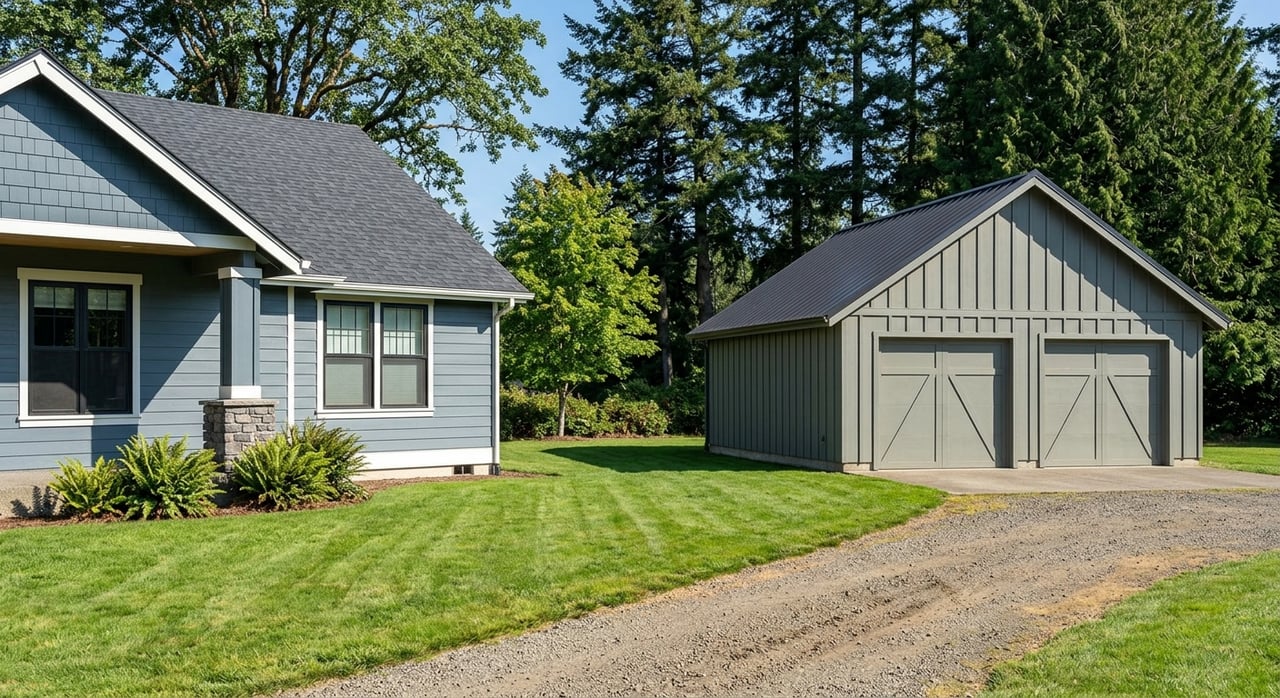
Many buyers are drawn to acreage because they want a barn, shop, greenhouse, or extra living space. Those features can add value and flexibility, but they should be verified carefully.
Oregon Building Codes Division says many structural, electrical, plumbing, and mechanical changes require local permits. A detached nonhabitable one-story accessory structure under 200 square feet and under 15 feet may be exempt from a building permit, but that exemption does not automatically cover plumbing, electrical, or mechanical work.
Marion County notes that for barns, shops, and accessory structures, a septic record review may be enough if there is no plumbing and no added bedrooms. If plumbing is added and gravity flow to the existing system is not possible, a septic alteration permit may be required.
This is a common point of confusion for acreage buyers. A finished shop or future guest-space idea is not only a construction question. It can also become a septic and permitting question.
Marion County’s AR code allows one accessory dwelling unit, but the rules are specific. The ADU must be no more than 900 square feet, must be within 100 feet of the primary dwelling, cannot be divided off from the main home, and cannot be used for short-term vacation occupancy.
In sensitive groundwater overlay areas, the ADU must also connect to a 1,000-gallon water-storage tank tied to the primary well. If multigenerational living is part of your plan, these details should be reviewed before you get too far down the road.
Acreage buyers sometimes focus on the home, land, and outbuildings while overlooking tax classification. Marion County Assessor says farm and forest special assessment programs can carry a Potential Additional Tax Liability, often shown as PAT LIAB, and that liability stays with the land, not the owner.
If the land is disqualified from the program, the result can be up to five or ten years of additional tax depending on the type of special assessment. The assessor also notes that building a house on specially assessed land can remove an acre from special assessment.
Before you plan major improvements, it is smart to verify whether special assessment applies and what effect your plans may have. That step can help you avoid surprises after closing.
Acreage homes reward careful due diligence. Before you move forward, make sure you have clear answers to the basics that shape value, use, and future costs.
Here is a practical checklist for the 97306 area:
These questions can help you separate a property that simply looks appealing from one that truly fits your plans.
Buying acreage often means coordinating information from Marion County Planning, Public Works or Building Inspection, the Assessor’s Office, and state well-water resources. It is a different process from buying a typical in-town home because more of the property’s value depends on records, land use rules, and physical systems that are not obvious from photos.
That is where experienced guidance can make the process feel much more manageable. With decades of Willamette Valley real estate experience, Debbie Brand helps buyers ask the right questions early, pull the right records, and spot issues that can be easy to miss from the listing alone.
If you are thinking about buying an acreage home in the Willamette Valley, Debbie Brand can help you approach the search with local insight, steady guidance, and careful attention to the details that matter most.


Get assistance in determining current property value, crafting a competitive offer, writing and negotiating a contract, and much more. Contact me today.